LG Tech Support

  • Subscribe to our RSS feed.
  • Twitter
  • StumbleUpon
  • Reddit
  • Facebook
  • Digg

Wednesday, 4 September 2013

Ask a Korean! Wiki: Language Courses for Children?

Posted on 19:17 by Unknown
Dear Korean,

I would love to go to Korea with my kids and spend about a month in the summer with them occasionally seeing relatives, but mostly I would like them to learn about the culture and language. They are half Korean and sadly speak no Korean but I'm hoping I could change that. Their ages range from 7-12 so a hefty program at Yonsei (which I did as a high schooler many years ago) would not be appropriate, but I'm sure there must be something they can do in Korea to learn the language in a more formal way. Do you have any suggestions?

Tina


The Korean is certain that this type of courses would be in demand, but unfortunately he is not aware of one. (Remember, the Korean never had to learn any Korean.) Readers, got any suggestion? Please share in the comment section.

Got a question or a comment for the Korean? Email away at askakorean@gmail.com.
Read More
Posted in | No comments

Saturday, 31 August 2013

Women Judges and Prosecutors?

Posted on 14:11 by Unknown
Dear Korean,

How many women judges are there in Korea? And how many female prosecutors are there? Have there been more females since the new president?

Cindy H.


According to Korea Women's Development Institute, 24.4% of the judges and 20.5% of the prosecutors are women as of 2010. There has been a constant increase of women judges and prosecutors in Korea that long pre-dates the new (woman) president. In 2008, for example, more than 70% of the newly appointed judges were women.

Got a question or a comment for the Korean? Email away at askakorean@gmail.com.
Read More
Posted in | No comments

Wednesday, 28 August 2013

Do North Koreans Look Different from South Koreans?

Posted on 19:37 by Unknown
Dear Korean,

Do North Koreans look different from South Koreans?

Ms. Trophy Wife


Short answer: not really.

One thing to remember about North and South Koreas is that they were the same country for a couple of millennia before having split into two countries for the last 60-odd years. So whatever differences that North and South Korea have in terms of language, customs, etc., tend to be minor. For example, the difference in the languages used in both North Korea and South Korea do not amount to more than differences in accent and certain diction, somewhat like the American and Australian English.

Likewise, there is no fundamental difference between the way in which North and South Koreans look. Having said that, however, 60-plus years is not a short amount of time, and the two Koreas did live through two very different worlds. South Koreans now live in one of the world's wealthiest countries, North Koreans one of the poorest. In particular, the crushing famine that North Korea suffered in the mid-1990s has left a visible impact on North Korean people's physique. While the average height of adult South Korean men is 171.5 cm (~5' 7.5"), the average height of adult North Korean men is 165.4 cm (~5' 5"). Because North Korean youths have become so malnourished, North Korea had to lower the minimum height requirement for its soldiers from 140 cm (~4' 7") to 137 cm (~4' 6") in 2010. (In contrast, South Korea recently had to extend the maximum height requirement from 196 cm (~6' 5") to 204 cm (~6' 8") for its conscripts.)

Aside from the difference in physique, the difference in the looks between North and South Koreans is essentially the difference in the wealth available to decorate oneself with fashionable clothing, cosmetics, hair care and (sometimes) plastic surgery. When given the chance to catch up to those additional "boosts," North Koreans--such as these defector ladies from a popular South Korean TV show about North Korean life--look like they will fit right in the streets of Seoul.

Got a question or a comment for the Korean? Email away at askakorean@gmail.com.
Read More
Posted in | No comments

Tuesday, 20 August 2013

Here are Some Korean Slang Terms

Posted on 20:47 by Unknown
Dear Korean,

Does the Korean have a list of colorful Korean language slang?

Cactus McHarris


This is actually a pretty tough task, because the number of slang terms is huge and the types of slang are ever-changing. For a comprehensive overview, the Korean would recommend As Much As a Rat's Tail: Korean Slang, a solid look of old and new slang expressions in Korean. In addition, KoreaBANG's glossary is a decent collection of the latest Internet-slang in Korea.

But the Korean will not simply abdicate this post to book and website recommendations. Although he could not possibly tally all the slang used in Korean language, he can try listing at least a few of them in this space. To that end, allow the Korean to re-introduce his all-Korean language Twitter account:  https://twitter.com/askakorean. The Korean decided long ago that his Facebook account will be for English language content, while his Twitter account will be for communicating with Korean folks--an arrangement that has worked out fairly well so far. And much like the Internet everywhere else, Korea's Twitterverse is full of hilarious slang and memes.

So here are some Korean slang terms ans expressions that went through the Korean's Timeline in the last several days. Keep in mind that this list is far, far from comprehensive, and may become outdated rather quickly. It only contains random samples of some of the slang that the Korean could see in the last several days before he wrote this post. But for curious people, it could be an interesting sampler of Korean slang terms.

The list of slang terms, after the jump.

Got a question or a comment for the Korean? Email away at askakorean@gmail.com.


갑이다 (v.) - to be the best. 갑 is the first letter in the old Sino-Korean counting system.

고고씽 (v.) - to move expeditiously; "go-go-ssing," with "ssing" being an onomatopoeia for moving quickly.

관광당하다 (v.) - to be pwned. Distortion of "강간당하다" (Literally, "to be raped".)
  역관광 (n.) - reverse pwnage. 

개고생 (n.) - very arduous endeavor, often unnecessary; literally, "dog endeavor".

개소리 (n.) - an utterly wrong statement; literally, "dog noise".

겁나 (adv.) - very. Contraction of "겁나게". (Literally, "scarily").

게거품 물다 (v.) - to be extremely upset; literally, "to foam at the mouth like a crab" 

괜춘하다 (v.) - to be ok; to be decent. Distorted form of "괜찮다".

까다 (v.) - to criticize; literally, "to kick".

꼰대 (n.) - a pedant; an annoying person who gives condescending lectures.
   Related:  꼰대질 (n.) - being a pedant.

꿀잼 (v.) - to be extremely fun. Contraction of 꿀맛같은 재미 (literally, "fun that tastes like honey").

남주 (n.) - male main character (in a novel, drama, movie, etc.). Contraction of 남자 주인공.
   Antonym:  여주 (n.) - female main character. Contraction of 여자 주인공.

넘 (adv.) - very. Contraction of "너무".

네임드 (adj.) - well-known. Korean pronunciation of "named", originates from MMORPG games that have "named weapons," i.e. unique and particularly strong weapons.

드립 (n.) - a joke. Contraction of "애드립 [ad lib]".
   Related:  드립력 (n.) - the ability to make jokes.
   Related:  드립치다 (v.) - make a joke.
   Related:  개드립 (n.) - a bad joke; literally, a "dog" joke.

땡기다 (v.) - to want. Distortion of "당기다" (literally, "to pull").

레전설 (n.) - a legendary story. Combination of "레전드 [legend]" and 전설.

멘붕 (n.) - (mental) devastation. Contraction of "멘탈 [mental] 붕괴".

뭥미 (int.) - "What?" Distortion of "뭐임?" ["What's this?"]

발리다 (v.) - to be pwned. Literally, "to be smeared (like butter)" or "to be flayed".

부심 (n.) - pride that is often excessive and unnecessary. Contraction of "자부심".
   Related:  슴부심 (n.) - pride held by women with big boobs. Contraction of "가슴 부심".

뻘짓 (n.) - dumb action.
   Related:  뻘트윗 (n.) - a dumb Tweet.

삽질 (n.) - dumb, useless action. Literally, "shoveling".

생축 (n.) - "Happy birthday". Contraction of "생일 축하".

솔까말 (adv.) - "to be completely honest." Contraction of "솔직히 까놓고 말해서".

시전하다 (v.) - to act or demonstrate, usually with mock ceremony

썰 (n.) - a story.
   Related:  썰 풀다 (n.-v.) - to tell a story. Literally, "to unravel a story."

안습 (adj.) - sad, pathetic. Contraction of "안구에 습기" (literally, "humidity in the eyeball", i.e. tearing up.)

야설 (n.) - a pornographic novel. Contraction of "야한 소설" (literally, "obscene novel').

어그로 (n.) - deliberate provocation, usually to spark an argument. Contraction of "aggressive" or "aggression".
   Related:  광역 어그로 (adj.-n.) provocation that aims at a great number of people, either by picking on a sensitive topic or by insulting a large group of people.

오덕후 (n.) - a nerd, with an unusual and specific area of interest (e.g. Japanese animation); Koreanization of "otaku"
   Synonyms:  덕후 (n.); 오덕 (n.); 덕 (n.). Contraction of "오덕후"
   Related:  십덕 (n.) or 씹덕 (n.) - a particularly nerdy nerd. Play on the word "오덕," which can be read as "five 덕" (while 십덕 can be read as "ten 덕").
   Related:  덕력 (n.) - breadth of knowledge in the area of geekery; literally, "nerd power".
   Related:  양덕 (n.) - Western nerd.
   Related:  밀덕 (n.) - nerd focusing on military weaponry. Contraction of "밀리터리 [military] 덕후". 

야매 (n.) - bootleg; fake or black market product.

염장 (n.) - kicking when someone's down; salting the wound. Literally, "salting".

이뭐병 (int.) - "What the hell?". Contraction of "이게 뭐야 병신아" ["What is this, you moron?"]

이빨까다 (v.) - to banter, usually in smart aleck; literally, "to uncover teeth".
   Related:  이빨 (n.) - smart aleck-y banter; literally, "teeth".

잉여 (n.) - a jobless, useless person; literally, "leftover".
   Related:  트잉여 (n.) - a useless person who spends too much time on Twitter. Combination of 트위터 ["Twitter"] and 잉여.

작업 (n.) - flirting. Literally, "work" or "operation".

좆 (n.) - penis.
   Related:  좆같다 (v.) - to be bad (as in quality).
   Related:  좆만하다 (v.) - to be little; literally, "as little as a dick."
   Related:  좆밥 (n.) - an insignificant thing; literally, "dick feed."
   Related:  좆나 (adv.) - very. Also distorted into 존나 or 조낸.
   Related:  좆까 (v.) - to fuck off; literally, "peel a dick." Also distorted into 조까.

재미지다 (v.) - to be fun.  Distortion of "재미있다".

짤방 (n.) - a picture. Contraction of "짤림 방지" (literally, "cut prevention"). Originated from a popular web community called DC Inside, which began as a digital photo sharing site. Because DC Inside would delete a post without a picture (as it was contrary to the purpose of the site,) people who frequent DC Inside to write about topics other than photography began adding just any photo.
   Synonym:  짤 (n.) - contraction of 짤방.
   Related:  혐짤 (n.) - disgusting or gross picture. Contraction of "혐오스러운 짤방" [disgusting 짤방]
   Related:  움짤 (n.) - moving gif. Contraction of "움직이는 짤방" [moving 짤방]
   Related:  먹짤 (n.) - picture of food. Contraction of "먹을 것 짤방" [food 짤방]

쩔다 (v.) - to be awesome, either in quality or scale.

천조국 (n.) - America. Literally, either "heavenly kingdom," a term that old Korea referred to China, to which it was a vassal state, or "the one trillion country," referring to the fact that U.S. annual budget is more than KRW 1 trillion.

최애캐 (n.) - favorite character; favorite person. Contraction of "최고 애정이 가는 캐릭터 [character]", originally used in the context of video games involving a lot of characters.

츤데레 (n.) - a shy and cold person who secretly has a heart of gold. Korean pronunciation of "tsundere."

칼침 (n.) - stabbing; "knife acupuncture".
   Synonym:  칼빵 (n.) - stabbing

케바케 (adj.) - case-by-case. Contraction of "케이스 바이 케이스".

퉁치다 (v.) - to call it even.

후죠시 (n.) - woman who likes gay men; Korean pronunciation of "fujoshi"
   Synonym:  후죠 (n.) - Contraction of "후죠시".
   Related:  후죠물 (n.) - movies, dramas or comics featuring gay men, aimed toward 후죠시 women.

흑역사 (n.) - embarrassing personal stories of the past; "dark history".

Got a question or a comment for the Korean? Email away at askakorean@gmail.com.
Read More
Posted in | No comments

Wednesday, 14 August 2013

The Good History Deniers

Posted on 21:07 by Unknown

Dear Korean,

A question on Quora reads: How do the Japanese think about World War II? I was wondering if this answer to the question is something that you would agree with. How would you respond?

Joel B.


Before reading this post, the Korean will highly recommending reading the answer provided by Ms. Makiko Itoh, which is linked above. August 15 is the V-J Day, when World War II ended in 1945 with Imperial Japan's unconditional surrender. On this important date, the Korean found it appropriate to address this question.

But first, a quick detour. Ta-nehisi Coates, likely the best contemporary American writer when it comes to discussing race relations, recently wrote a terrific New York Times op-ed entitled The Good, Racist People. The message that Coates delivered through the op-ed is simple and devastating: even good people with sincerely good intentions contribute to, and perpetuate, racism in America. When it comes to dealing with large-scale, historical evil, it is not enough for one simply live with good intentions--because road to hell is paved with such good intentions.

The same is true with the way the Japanese approach World War II. I have said this before, and I will say it again: Japan, as a whole, think that it did nothing wrong during World War II. The steady stream of outrageous statements made by prominent Japanese politicians and intellectuals can only continue in an environment in which such worldview is tolerated. (Just two of the latest hits: (1) Japan's Deputy Prime Minister said Japan should amend its Peace Constitution like the way Nazis amended the Weimar Constitution; (2) Japanese navy built the largest ship since WWII and named it "Izumo", one of the ships that were used to invade China.)

When news of such outrageous statements hit the wire, a common response is to attribute it simply to a small faction of right-wing, nationalist Japanese people, implying that the vast majority of the Japanese ought to be spared from the responsibility of such historical amnesia. This is incorrect on several levels. First, the Japanese right-wing is anything but small. The Japanese nationalists are currently dominating the political scene, winning the last two parliamentary elections in a landslide. Their leader, Prime Minister Shinzo Abe, proclaimed that he would withdraw Japan's apology to former Comfort Women and denied that Imperial Japan forcibly recruited the Comfort Women to serve as sex slaves. Right-wing thugs roam the streets freely in broad daylight, waving the "Rising Sun" flag, blaring propaganda from their infamous "black vans" and engage in harassment campaigns against Koreans living in Japan.

Nationalist black van, commonly seen
in the streets of Japan
(source)
For those who will predictably chime in about how Abe's election was more about the sagging Japanese economy: so was Hitler's election. In a normal country, a candidate's penchant for denying war atrocities would be met with swift termination of the candidate's political career, regardless of his views on economic policies. That did not happen with Abe, which speaks volumes. The mindset of the good, moral Japanese people that elected a man like Shinzo Abe is equally responsible for Japan's collective denial of history.

(More after the jump.)

Got a question or a comment for the Korean? Email away at askakorean@gmail.com.


A recent interview by Hayao Miyazaki reveals the epitome of such mindset. Miyazaki, of course, is a legendary anime filmmaker, creating such masterpieces as Nausicaa of the Valley of the Wind, Castle in the Sky, Princess Mononoke, and Spirited Away. More importantly for the purpose of this post, Miyazaki is hardly an apologist for Imperial Japan. A staunch leftist, Miyazaki pointedly criticized Abe administration's attempt to re-write history: "Japan should have properly apologized to Korea and China, and settle the debt of the past." One can fairly say that, among mainstream Japanese people, Miyazaki is about as good as they come when it comes to recognizing Japan's responsibility for World War II.

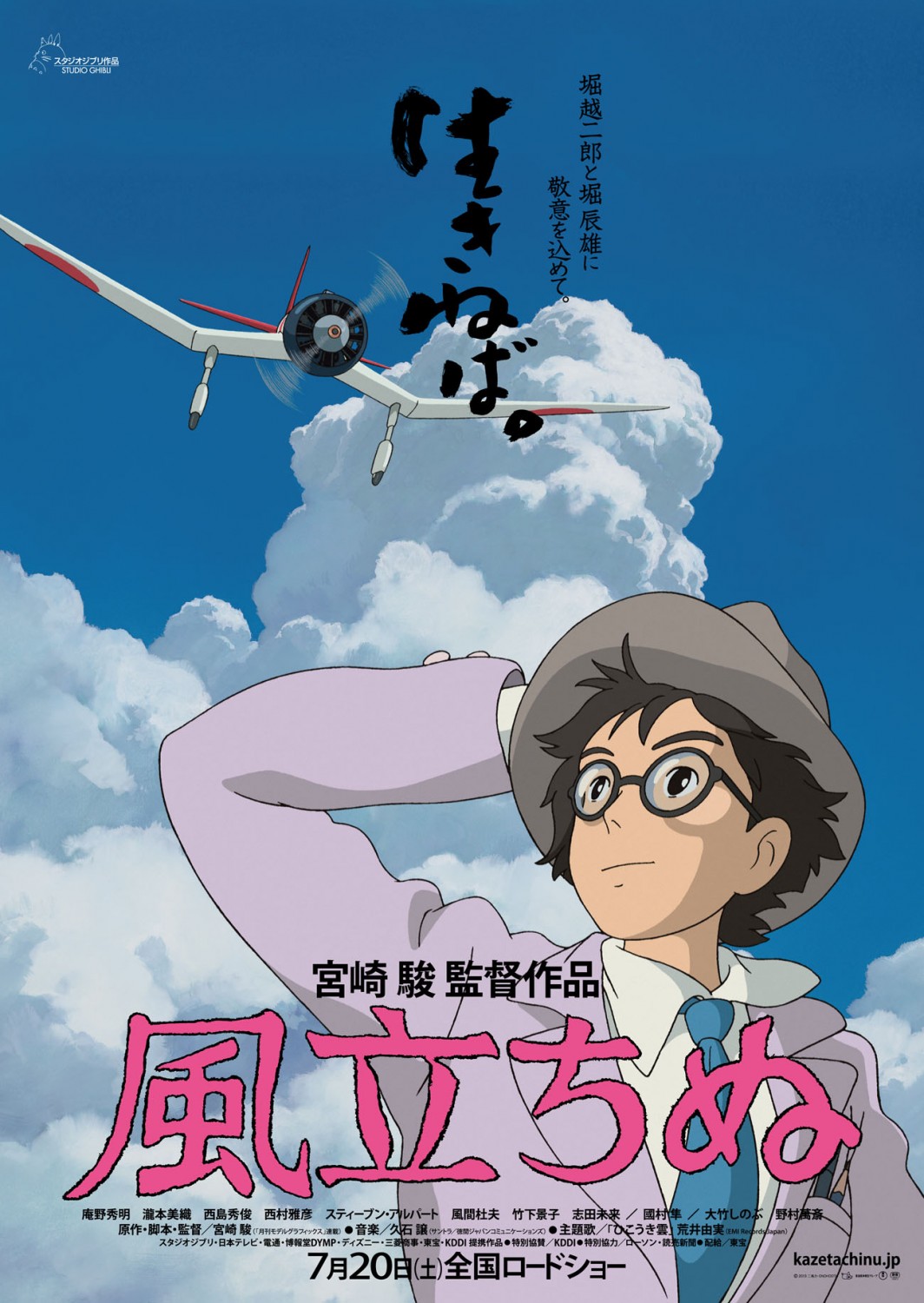
Poster of Kaze Tachinu, showing
Jiro Horikoshi and his Zero Fighter
(source)

So it may be slightly surprising that Miyazaki's latest work, Kaze Tachinu ("The Wind Blows"), is a movie depicting the life of Jiro Horikoshi, the engineer who designed the infamous Zero Fighters, the mainstay of the Japanese Air Force during World War II that was used to bomb the Pearl Harbor, among other missions. In a revealing interview with Asahi Shimbun, Miyazaki explained the thought process behind making a movie about the face of the Japanese war machine during World War II. The relevant portions of the interview is worth quoting at length:
Q:   In the movie, there is a scene that shows Jiro Horikoshi standing before a destroyed airplane after the war ended.

A:   I think his heart was destroyed. He worked toward his dream of making a beautiful airplane, and his effort hit the peak as he was designing the 96 Fighter and the Zero Fighter. But during the war, he was directed to come up with a new model or improve the Zero, because of the lack of engineers during the war. It is like ordering Studio Gibli [Miyazaki's studio] to make five new movies each year without hiring anyone new. He did his best, but most failed. But he had his own pride that told him, "I did not lose." He wrote, "they say we are responsible for the war, but I don't think I am."

Q:   Yoshitoshi Sone, one of the engineers who assisted Jiro Horikoshi, reportedly said: "This is terrible. If this many people were going to die, we should not have built this. We should not have designed this," upon seeing that the Zero Fighters were used in kamikaze missions. Was Horikoshi thinking differently?

A:   Sone may have felt that way, but at the same time he must have felt: "That is not my area to be concerned about." Of course, Horikoshi carries the responsibility of the war as a Japanese citizen; but one engineer need not be responsible for the entire history. I think it is pointless to talk about responsibility.

I understand Sone's sentiment that he should not have built the plane. But I think it would have been a less rewarding life if he did not build the plane. I communicated this in the movie too, but the plane is a beautiful but cursed dream. One builds what one wants to build, gets cursed by it and gets injured by it. But Sone must have thought later that it couldn't be helped. It was better to live that era, giving his all. At the time, no one could arrogantly claim that this was good, and this was bad.

Q:   Your father owned a military supplies factory and manufactured Zero Fighter components; he reportedly became nihilistic as he experienced the earthquake and the air raids.
A:   Nihilism sounds cold, deviant and vulgar; that was not my father. He merely thought his family came first. Through his terrible experience of the apocalypse, he gave up on the big talks like "this value is important" or "this is how humans ought to be." He tried to protect his family, his friends and whom he could, but thought he could not be responsible for the entire country or the society. He always said: "Don't lose out."

Q:   Do you also feel that way, at this point?

A:   Maybe a radius of 30 meters, or 100 meters? That is the limit of the area that I can affect, and I have no choice but to accept that that is all I can do. Before, I thought I had to do something for the world or the mankind, but I changed a great deal now. ...

. . .

Q:   Although you say you can only be responsible for those around you, you are affecting a lot of people through your movies.

A:   Movies is my job, not some cultural project. They just happened to find commercial success. Without the viewers, they will all go away in an instant. The people who joined Gibli think it is a stable company, but that's laughable.
Interview with Hayao Miyazaki, the Zero Fighter Designer's Dream [Asahi Shimbun]

Reading this interview, a theme emerges: a small individual who can not do much to the overwhelming forces of the world. Because the individual, at best, can only do so much, the best course of the individual is to simply do what he wants to do with all his heart. All Horikoshi wanted to do was to build beautiful flying machines; all Miyazaki wants to do is to make movies that sell. It is better that they keep building the most beautiful flying machines, the best selling movies, without thinking too much about what those machines and movies may do. After all, they cannot control how their machines will be used, how their movies will be interpreted.

Such view may be somewhat defensible. It is certainly a big step up from the odious views of the Japanese right-wing, who denies all of Japan's responsibility for World War II wholesale. There is enough room in this worldview for one to feel sympathetic. The Japanese during World War II certainly were not the first ones who committed acts of horror by getting swept up into the roaring currents of history.

Nonetheless, it is deeply disappointing that this is the best that the well-meaning Japanese people can muster up, because in this worldview, there exists its own version of history denial and responsibility evasion. The good history deniers of Japan may acknowledge that terrible things happened during World War II. Yet those terrible things are nobody's fault. It was certainly not the fault of the ordinary Japanese people, who were simply living their lives. In this story, Japan may be the country that invaded Korea, Manchuria and China, bombed Pearl Harbor, brutalized Nanking and POWs in the Philippines, conscripted hundreds of thousands of women to serve as sex slaves and performed live human experimentation--but no Japanese person committed those horrible things. Those things just kind of happened.

Note the selective obliviousness in which Miyazaki engages to maintain his worldview. Miyazaki laments that he can do no more than affect a "100 meter radius" from himself. This is an absurd claim. Miyazaki is easily one of the most influential filmmakers of the 20th century. Contrary to his assertion, Miyazaki's movies are much more than money-making ventures that randomly found success; they are canonical works of art in the history of animated movies, which are revered by millions of people worldwide. Yet Miyazaki must abdicate from that lofty perch if he is to maintain that individuals cannot affect the world in which they live. Otherwise, Jiro Horikoshi--the man who designed the symbol of the Japanese war efforts--cannot remain an innocent boy who only wanted to make beautiful flying machines. He becomes a full participant of the war that Imperial Japan caused.

Such selective obliviousness is likewise evident in Ms. Itoh's answer on the Quora question. Ms. Itoh wrote:  "The general feeling was that the military government was doing whatever they wanted, without the knowledge or consent of the regular citizens of Japan." This claim is equally absurd as Miyazaki's claim of powerlessness. World War II was an unmissable event for Japan. It was the polar opposite of the American war in Iraq, in which regular American citizens rarely felt the impact of the war because it was fought by a small group of Americans with only a fraction of the national economy dedicated to the war. In contrast, the Japanese war effort during World War II required the mobilization of the entire country.

The Imperial Japanese Army boasted 10 million soldiers, vast majority of which was drafted. At least 500,000 Japanese were living in Japan's colonies (such as Korea and Manchuria.) A huge number of Japanese worked for large corporations that constructed the Japanese war machine, such as Mitsubishi Heavy Industries. The Japanese newspapers did not simply report the news of military victory; it was boasting the stories of two soldiers engaged in a contest to be the first to kill 100 people with a sword as they were marching toward Nanjing, to commit one of the worst brutalities of the 20th century.

Tokyo Mainichi Shimbun reporting the contest to cut down 100 men.
(source)
It is simply not true that the ordinary Japanese had no idea that their country was committing such horrors. On a certain level, every Japanese knew that they were invading sovereign countries and killing people. Yet the good Japanese like Ms. Itoh must insist that the regular Japanese people simply did not know, because admitting the truth--that the ordinary Japanese sincerely believed in their mission as they enslaved other countries and killed its people--would require them to face up to the responsibilities for such horrors.

This is a far cry from the way in which post-war Germans addressed their wartime legacies. With a slogan like "Collective guilt, no! Collective responsibility, yes!", Germans engaged in vigorous, decades-long debate and exploration of what that collective responsibility means, and how it applies to each individual German who lived through that era and the children of those individuals. A book like The Reader by Bernhard Schlink, which attempted to show the human aspect of the Nazi guards, would become subject to strong criticism within Germany, for insinuating that the Nazi followers were dumb, illiterate people who did not know better. Yet in Japan, this is the standard position among well-meaning people.

This difference in attitude results in meaningful difference in the way in which World War II is remembered in different theaters. The lasting image from World War II concerning Germany is the Holocaust, not the bombing of Dresden. By all rights, the lasting image from World War II concerning Japan ought to be the Rape of Nanking, Unit 731, Bataan Death March and Comfort Women. Instead, the lasting image from World War II concerning Japan is the mushroom cloud over Hiroshima. To be sure, the atomic bombing of Hiroshima was a horrific event. But never in Japan's memorial of Hiroshima do the Japanese acknowledge that Imperial Japan was the one responsible for invading other countries and killing more people than the Nazis. Because the good Japanese chose not to address their personal contribution to World War II, the suffering (which was indeed immense, but not greater than Germans' or any other people's) that the Japanese did undergo during World War II is not recognized as a consequence of Japan's wrongdoing. Instead, those sufferings just kind of happened for no reason, like a natural disaster. (Note that the Asahi Shimbun interviewer juxtaposes "earthquake" and "air raid" as formative experiences for Miyazaki's father.)

Of course, the flip side of this attitude means that even the war atrocities that Imperial Japan caused is also like a natural disaster that just kind of happened. Because the damage that Japan caused to others during WWII is the moral equivalent of the damage that Japan suffered during the War, the best lesson that these good Japanese can draw from the war experience is no more than the naive conclusions that war is bad, politicians lie, and the best thing to do is to just live their lives without aspiring to steer the course of their own country.

Such abdication from historical responsibility is what has guided Japan since the end of World War II. The good Japanese people removed themselves from the political process by engaging in their own, smaller distortions of history. Only the Japanese right, who still believe that the Imperial Japan did nothing wrong, remained as the active driver of Japan's political course.

Nearly as soon as Japan exited the American provisional rule, it elected as Nobusuke Kishi as the Prime Minister. Kishi, a key leader of the Japanese colony in Manchuria who was tried as a Class A war criminal. (Imagine seeing Hermann Goring as the chancellor of West Germany in 1957!) Kishi sincerely believed that the only sin committed by the Imperial Japan during World War II was to lose the war. In an infamous episode, when Kishi was imprisoned on the charges of war crime, his old teacher sent him a message: "If you consider your name that will carry for thousand years, commit suicide." Kishi replied defiantly: "Instead of my name, I will proclaim the legitimacy of the holy war [World War II] for ten thousand generations." A master politician, Kishi maneuvered to position his party--the Liberal Democratic Party--to hold the power in Japan for the entire post-war period except for two stretches of three years. Naturally, the LDP has maintained staunch historical revisionism as to Japan's role in World War II. In 2007, for example, 120 LDP members of the parliament sought to retract the Kono Statement, the Japanese government's official statement of apology to former Comfort Women. (The Kono Statement was made in 1993, when LDP briefly lost power.)

Today, yet another head of LDP serving as Japan's head of state after having won two landslide elections. Shinzo Abe, grandson of Nobusuke Kishi, is proceeding with full speed ahead to completely deny Imperial Japan's responsibility for World War II. He denied that the Japanese military kept sex slaves; proclaimed that he would revise the Kono Statement (before backing off after massive international pressure); gave a grinning thumbs-up sitting in a fighter jet numbered 731 (as in Unit 731) and; is leading the movement to amend Japan's pacifist constitution. And the good Japanese people, the well-meaning history deniers, are allowing all of this to happen, as they have for the last 50 years.

Got a question or a comment for the Korean? Email away at askakorean@gmail.com.

Read More
Posted in | No comments

Saturday, 10 August 2013

"Good Writer, Bad Writer" on AAK!

Posted on 17:02 by Unknown
The Korean frequently receives questions along the lines of: "I think your writing is great? How do I become a good writer?" For a few times, he has tried writing a post in response to such questions, and felt too embarrassed to continue. To be sure, the Korean does have a number of principles and guideposts in his mind when he writes. He does strive to be a better writer each time. But the truth is that his writing is still much lower quality than he would prefer. Because this blog is a hobby, he never does put in the amount of effort that he feels sufficient. Consequently, a reader with sharp eyes can usually find persistent errors and rooms for improvement in the Korean's writing. So it felt a bit silly to talk about how to write well, when he was not even living up to his own standards.

Luckily, Mr. Shawn Doyle, who is a writing teacher, has been generous enough to use my recent post, Culturalism, Gladwell and Airplane Crashes as an example of effective writing. At his blog, Good Writer, Bad Writer, Mr. Doyle has reproduced the post, and kindly provided a play-by-play on the rhetorical strategy that the Korean has employed as he wrote the post. If you happened to be one of the folks who thought the Korean's writing was worth emulating, the post at Good Writer, Bad Writer would be helpful.

One tip that the Korean would give about writing is: have an arsenal of several esteemed writers whose style you can emulate depending on the purpose of your writing. For the purpose of the Culturalism post, the Korean was consciously trying to write like Chief Justice John Roberts, who is considered one of the greatest writers that the Supreme Court has seen since Robert Jackson. I think Justice Roberts writes  like a freight train coming down a hill. At first, the train would be stationary, sitting on top of the hill with no freight on it. Justice Roberts would begin his writing by adding freight piece by piece onto that train. After a certain point, the train would start slowly rolling downward, unable to bear its own weight any longer. By the time the train reaches the bottom of the hill--i.e. the conclusion of his writing--it moves with such momentum and speed that makes the conclusion undeniable. 

The Korean knows this style is effective because he usually disagrees with the legal points that Justice Roberts makes. So it feels amazing (and a bit infuriating) when he finishes reading an opinion by Justice Roberts, and feels halfway convinced of the Justice's arguments before snapping out of it. Accordingly, the Korean attempts to deploy this style when he tries to write a strongly opinionated piece. Based on the reception the post had, it appears that the strategy worked this time.

Thank you very much, Mr. Doyle, and thank you everyone for reading.

Got a question or a comment for the Korean? Email away at askakorean@gmail.com.
Read More
Posted in | No comments

Wednesday, 7 August 2013

The Weather Channel Explains Fan Death

Posted on 19:17 by Unknown
So there is this:


Hot room + fan directly on the body = heat exhaustion and/or heat stroke. Gee, that sounds awfully like how Fan Death works.

Got a question or a comment for the Korean? Email away at askakorean@gmail.com.
Read More
Posted in | No comments
Newer Posts Older Posts Home
Subscribe to: Posts (Atom)

Popular Posts

  • Grammar Rule: Beginning-Sound Rule [두음법칙]
    Dear Korean, Why is the Korean family name 노, as in 노태우 and 노무현, anglicized as "Roh"? It's both spelled and pronounced as ...
  • Ask a Korean! News: Sen. Grassley Says Goodwin Liu has "Communist China" Mindset
    Here is a bit of a background. Goodwin Liu is a professor and associate dean of Boalt Hall Law School at U.C. Berkeley. President Obama nomi...
  • 50 Most Influential K-Pop Artists: 20. Crying Nut
    [ Series Index ] 20.   Crying Nut [크라잉넛] Years of Activity: 1998-present Members: Park Yoon-Sik [박윤식] - Vocal, Guitar Lee Sang-Myeon [이상면...
  • (no title)
    According to a survey by Mastercard, the most favored out-of-country travel destination for Koreans was Japan: 36 percent of Koreans who wer...
  • The Mosquito Truck
    Dear Korean, What chemicals are used in the mosquito fogging trucks and are they harmful to people? If so, why are they so accepted by Korea...
  • Pop Music Disappointments, and K-Pop
    The Korean saw this some time ago:   12 Extremely Disappointing Facts about Popular Music . Just to give a few samples: Flo Rida's “Low”...
  • IMF Bailout of Korea During East Asian Financial Crisis -- Interlude
    [ Series Index ] How ironic is it that as this blog discusses the IMF bailout of Korea during the East Asian Financial Crisis of 1997-98, U....
  • 50 Most Influential K-Pop Artists: 21. Lee Seon-Hee
    [ Series Index ] 21. Lee Seon-Hee [이선희] Years of Activity: 1985-present Discography: Oh the Good Old Days [아! 옛날이여] (1985) Lee Seon-Hee v...
  • 50 Most Influential K-Pop Artists: 19. Kim Wan-Seon
    [ Series Index ] 19.  Kim Wan-Seon [김완선] Also romanized as:   Kim Wan Sun Years of Activity:  1986-present? (Last regular album in 2005, a s...
  • 50 Most Influential K-Pop Artists: 30. Sinawi
    [ Read more reviews from the Korean from the   Library Mixer . To join,   click here .]   [ Series Index ] 30.   Sinawi [시나위] Also Romanized...

Blog Archive

  • ▼  2013 (73)
    • ▼  October (3)
      • Name Change in Korea
      • 50 Most Influential K-pop Artists: 12. Rain
      • Excreting the Dregs
    • ►  September (5)
    • ►  August (7)
    • ►  July (8)
    • ►  June (7)
    • ►  May (6)
    • ►  April (8)
    • ►  March (18)
    • ►  February (6)
    • ►  January (5)
  • ►  2012 (101)
    • ►  December (8)
    • ►  November (6)
    • ►  October (3)
    • ►  September (6)
    • ►  August (2)
    • ►  July (6)
    • ►  June (8)
    • ►  May (7)
    • ►  April (13)
    • ►  March (13)
    • ►  February (12)
    • ►  January (17)
  • ►  2011 (294)
    • ►  December (24)
    • ►  November (19)
    • ►  October (25)
    • ►  September (22)
    • ►  August (24)
    • ►  July (17)
    • ►  June (25)
    • ►  May (23)
    • ►  April (33)
    • ►  March (30)
    • ►  February (22)
    • ►  January (30)
  • ►  2010 (32)
    • ►  December (24)
    • ►  November (8)
Powered by Blogger.

About Me

Unknown
View my complete profile