LG Tech Support

  • Subscribe to our RSS feed.
  • Twitter
  • StumbleUpon
  • Reddit
  • Facebook
  • Digg

Saturday, 2 March 2013

Korea's Gunless Fight Against Tyranny

Posted on 12:35 by Unknown

The memorial near Sandy Hook Elementary School
(source)

Regular readers of this blog are probably well-acquainted with the Korean's aversion to American gun culture. In the wake of the Newtown Massacre and the gun control debate that followed, Andrew Sullivan, popular political commentator and an immigrant from Great Britain, wrote:
Gun violence is one of those things that an immigrant is first amazed by in America. The second thing a non-American is shocked by is the sheer passion of those who own and use guns in this country.
As an immigrant to the United States, I share that sentiment. America’s gun violence, and its love for guns in the face of such gun violence, make no sense to me. To be sure, I understand the recreational value of guns: if you like hunting, for example, I have no objection that you love your hunting rifle. But we all know that the current gun debate is not about hunting rifles--it is about the widespread and under-regulated gun ownership.

Because I so relentlessly advocate for strict gun control, I have encountered equally relentless counter-arguments from gun advocates who would not countenance any regulation of their firearms. From those encounters, I found that every pro-gun argument falls into one of five categories. They are:
  1. Red herring: "Guns are not the problem; violent video games/mental healthcare/racial minorities are the problem."
  2. Legal:  "Gun ownership is a fundamental right guaranteed by the Constitution."
  3. Public policy:  "More guns prevent crimes."
  4. Pragmatic:  "It is not practically possible to eliminate guns from the United States."
  5. Political philosophy:  "Civilian gun ownership prevents tyranny."
All five of them are wrong, and it is quite easy to show how they are wrong. The first argument is a genuinely dishonest red herring. When pressed, even gun advocates have to admit that guns make deaths happen much more easily and efficiently. Whatever murderous tendencies Americans may have, there is no question that guns provide an easy connection murderous tendencies and actual deaths. A data point here would suffice: suicidal acts with guns are fatal in 85% of the cases, while suicidal acts with pills are fatal in 2% of the cases. (This is why we arm our military with guns, not pills.) And regulating a single category of item makes much more sense than, say, putting every single American through mental examination or pre-screening all video games to make sure none of them is too violent.

The legal argument is also wrong. Here, I particularly delight in exposing the self-made constitutional scholars, since I wrote a lengthy paper about the Second Amendment implications before District of Columbia v. Heller was decided in 2008. To be sure, Heller was a laughable decision. It was a 5-4 decision a la Bush v. Gore, i.e. straight along the partisan line. More importantly, Heller--which was decided only five years ago--was the very first Supreme Court case ever to find that the Second Amendment guaranteed individual rights of gun ownership, even though the Second Amendment has existed for more than 200 years. In doing so, the five conservative justices of the Supreme Court overturned hundreds of years of legal precedents that have held, consistently, that there is no individual right to gun ownership under the Constitution.

But even if we are to treat Heller as the law of the land--and we must, out of respect for the Constitution--the Heller opinion itself clearly leaves room for increased gun ownership control:  “nothing in our opinion should be taken to cast doubt on . . . laws imposing conditions and qualifications on the commercial sale of arms.” In short, there is nothing unconstitutional or illegal about, say, banning all assault weapons or high-capacity magazines from civilian ownership. Likewise, there is nothing unconstitutional or illegal about instituting a gun buy-back program, or imposing a significant amount of tax on every gun and bullet sold (as long as the tax is not so great that it effectively acts as a bar to ownership,) or requiring every gun owner to purchase a liability insurance.

Public policy argument is just as easy to dispatch. Numerous studies confirm again and again that having guns at home doubles the risk of homicide. This holds true at an international level as well. Among developed countries, United States has incomparably high gun ownership rates, and likewise has incomparably high rates of both gun-related homicide and ordinary homicide. The developed countries that do have high (but nowhere nearly as high as U.S.) rate of civilian gun ownership have a level of gun control that would be unimaginable in the current-day United States. Switzerland, for example, requires that the citizens keep all their bullets in the army barracks.

The pragmatic argument appears to be sensible in the first blush, but quickly loses its strength in the face of a real world example. After a mass shooting in 1996, Australia instituted a gun buy-back program that reduced the civilian ownership of guns by 20%. In the next 10 years, Australia's firearm-related homicide plunged by 59%, while non-firearm homicides remained the same. What is more, the firearm-related homicide dropped more precipitously in Australian states that had higher gun buy-back rates. (As a bonus, firearm suicides fell by 74%.) In fact, Australia's example shows the hollowness of the "public policy" argument as well. In all likelihood, only law-abiding citizens would participate in a gun buy-back program. Then how is it that gun-related homicide dropped by nearly 60%, when (according to gun advocates) only "bad guys" would have guns?

That leaves us the "political philosophy" argument--the idea that we need guns to overthrow tyranny. And this is the real reason why I write this post, to address this risible argument.

(More after the jump)

Got a question or a comment for the Korean? Email away at askakorean@gmail.com.


Of the five arguments against stricter gun control, this "political philosophy" argument is personally the most grating. It is not just that the argument is wrong; the other four arguments are wrong as well, but they do not grate me as much. People are often wrong, and with enough facts and data, they can be shown wrong. This is a process that we go through all our lives, and peace of mind would be difficult to attain if this process unsettles you.

To me, the political philosophy argument is grating not because it's wrong; it is because the argument is absurd. A typical American gun advocate simply has no idea what it’s like to live in an actual, real-life tyranny, because America is the oldest and strongest democracy in the world. (And it is quite telling that the sub-population of Americans who did experience real-life tyranny, e.g. African Americans, are nowhere to be found among contemporary gun advocates.) Because American tyranny only exists as a fantasy, American response to the potential coming tyranny is also fantastical--thus, we have such risible statements as "there would have been no slavery if African Americans had guns" or "there would have been no Holocaust if Jews had guns." Yet the true believers can go on saying these absurdities for one simple reason: it is particularly difficult to have a counter-example that is "within all fours," as lawyers like to say. 

But there indeed is such a counter-example. South Korea suffered under tyranny for 40 years, then achieved freedom without resorting to armed revolt. But before they did, South Koreans tried an armed revolt first. That's the story I would like to tell here.

*             *             *

Although North Korea grabs all the headlines for its totalitarianism, it is lost on most people that, for the first few decades of its existence, South Korea was not much better than its northern brethren. The current Republic of Korea (South Korea) was established in 1948. Although nominally established as a democracy, the country was not fully democratized until 1987.

In the four decades between its birth and full democratization, South Korea would undergo three fascist dictators. The first one, Syngman Rhee (who was also South Korea’s first president,) ruled for 12 years by rigging elections at first, then later declaring himself to be the lifetime president. A popular protest overthrew him and established a democratic government. (Rhee fled to Hawaii, where he died.) That democratic government lasted a year and a half, until the second dictator, Park Chung-hee, rolled into Seoul with tanks to depose the democratic government. He, too, rigged elections and declared himself to be the lifetime president. Park proceeded to rule the country for 18 years, until he was assassinated. Amid the chaos that followed, the third dictator--Chun Doo-hwan--again rolled into Seoul with tanks and anointed himself to be the president. He ruled for 7 years, until 1987.

When I say Rhee, Park and Chun were fascists, I literally mean the term “fascists.” They were real, true fascists who commandeered the Korean economy and fattened their own coffers. (Chun was found to have collected more than a billion dollars during his seven-year reign into his slush fund, a staggering sum for South Korea of the 1980s.) They held up newspaper editors at gunpoints and dictated what the newspapers should say. If the Korean people criticized their rule, they were beaten, tortured and killed. If a leader emerged in the opposition, they jailed and/or assassinated the leader.

Yet today, South Korea boasts the most robust democracy in East Asia. In 2013, it is virtually unimaginable that South Korea would backslide into another round of military rule. South Korean democracy is operates efficiently enough to foster its world-class businesses. South Korean democracy creates peaceful resolutions to fractious political issues in accordance with the rule of law. In its quarter-century history, South Korean democracy already experienced two peaceful transitions of power--conservative to liberal, then again to conservative. 

What is more, South Korean democracy serves its essential function: check the excesses of power in accordance with the rule of law. In 1996, the democratic Korean government successfully prosecuted Chun Doo-hwan to life in prison. When the sons of presidents Kim Young-sam and Kim Dae-jung were alleged to have received bribes, Korea’s justice system investigated them and put them into jail. When president Roh Moo-hyun in 2004 was alleged to have violated election laws, he was impeached. Korea’s press serves their rightful role as the watchdog, being independent (albeit with commonplace journalistic slants,) loud and activist.

In short, South Korea is a free country--although, only a quarter century ago, it was not. And Korean people managed to achieve this peacefully, without resorting to guns.

*                 *                 *

I have told this story enough times to know that, right around this point of the story, the gun advocate would interject: “But you never know what would have happened if Koreans did have guns. If Koreans had guns, the dictatorship may have fallen in 10 years or 20 years instead of 40.” But actually, Koreans did try the armed insurrection option first.

The second dictator, Park Chung-hee, was assassinated in October 1979. But the Korean people’s brief hope for democracy was almost immediately dashed, when Chun Doo-hwan rolled into Seoul with tanks in December 1979. For the first few months afterward, Chun attempted to co-opt the democratization activists into his faction, hoping that the activists would support the military’s role in politics. But Korea’s democratization activists soon saw through Chun Doo-hwan to be as much of a dictator as Park Chung-hee. In early May 1980, the activists resumed their demands for democracy and protests in the streets. In response, on May 17, 1980, Chun Doo-hwan declared martial law nationwide, dissolved the National Assembly and arrested 2,699 opposition leaders and democratization activists. Pursuant to the martial law--which is really no law at all--Chun Doo-hwan sent the military to all major cities to quell any organized opposition to his ascendance. One of the objectives of the military was to drive out the students from college campuses, traditionally the epicenter of democratization movement.

In the southwestern city of Gwangju, the sixth largest city in Korea which many of the democratization movement leaders called home, the protesters took a stand. On the morning of May 18, the day after the nationwide martial law was declared, some 800 Jeonnam University students gathered outside of the gates of their campus in Gwangju, and demanded the paratroopers who were guarding the gate to step aside, so that they may attend their classes. The paratroopers beat the students with billy clubs; the students responded by throwing rocks at the paratroopers. Students then retreated into the city; the paratroopers gave chase, and began indiscriminately beating any Gwangju citizen who got in the way.

Paratroopers beating Gwangju citizens, on May 19, 1980.
(source)
The next day, Gwangju was in a full-blown rebellion with tens of thousands of protesters, as regular Gwangju citizens, enraged by the paratroopers assault on the city, joined the student protesters. The military government sent reinforcement, with orders for a more brutal crackdown. Paratroopers were now armed with bayonets, and went on a beating and stabbing rampage across the city. They would kill the first Gwangju citizen that day; a thirty-year-old deaf man was dead from brain hemorrhage after having been beaten from the paratroopers. The fight continued the next day, with the protesters setting up barricades and raining rocks upon the paratroopers. The events would take a fateful turn at around 11 p.m. on May 20. At the Gwangju train station plaza, the paratroopers opened fire to the protesters. Three protesters died on the spot; dozens more were injured. Having learned that the military government was ready to shoot and kill civilians, the citizens of Gwangju began to arm themselves.

This scene might warm the heart of an American gun advocate. Indeed, this scene may as well be the exact type of romantic image that the “we-need-guns-to-fight-tyranny” folks have been dreaming of. Because the citizens of Gwangju were able to raid the nearby military armories, they were armed with military grade weapons, including walkie-talkies, assault rifles, M2 machine guns, hand grenades and TNTs. The citizen militia even had KM900 armored cars (!) as they raided an automobile plant in Gwangju that manufactured armored cars. What is more, Gwangju’s citizen militia actually knew how to properly use these weapons. Because nearly every Korean male served (and still serves) two years of mandatory military service, Gwangju’s citizens did not face a deficit of disciplined organization against the incoming military government’s forces.

In fact, the entire city of Gwangju organized with discipline. Although there was no police or any other law enforcement, there was no looting or disorder. Although every man was armed, there was no robbery. The citizen militia took over the local granary and distributed food in an orderly fashion. Those with medical training volunteered to tend the wounded; people lined up to give their blood. Womenfolk delivered food, ammos and messages to the militia in the forward positions. Most importantly, just like they learned in the military, the armed citizens of Gwangju fortified key buildings of the city, and waited for the advance.

Women of Gwangju preparing rice for the civilian militia. Photo taken on May 22, 1980.
(source)
(For more photos of the Gwangju Uprising, visit the official online photo archive here.)

The city would remain free for one week. On May 27, 1980, the paratroopers, escorted with tanks, overran the provincial office of Gwangju, the citizen militia’s last holdout. The entire episode--later termed Gwangju Democratization Uprising--claimed more than 600 lives, including eight young children under the age of 14. More than three thousand Gwangju citizens were injured; nearly 1,600 people were arrested, and were tortured for days, months. The trauma from the arrest was so great that more than 10 percent of those arrested committed suicide after release.

*               *               *

Does freedom require civilian gun ownership? If your answer is yes, here is a follow-up question--why is it that so many oppressed people around the world, who are keenly aware of their oppression and are doing everything to fight for freedom, are not clamoring for the right to civilian gun ownership? American democracy is the envy of the world, the ultimate model for the emerging democracies. How is that none of those emerging democracies have guaranteed a right to civilian gun ownership, even as they emulate American democracy?

This was also the case for the South Korean democracy, which was explicitly modeled after the American one--after all, the first constitution of South Korea was practically written by American attorneys and legal scholars. Korea’s democratization activists enthusiastically called for all the peculiar features of America’s democracy to be incorporated into Korean democracy, such as freedom of speech and press or the checks and balances of the three branches of the government. 

But not civilian gun ownership. In fact, South Korea has been one of the most gun-free societies in the world from the beginning of the republic, through the military dictatorships and as a democracy today. This is not because Koreans are effete sissies who are irrationally afraid of guns. Nearly every Korean male serves his military duty, during which he constantly handles weapons. Indeed, as a society, Korea may have a healthier “gun culture” than the U.S., since everyone who is likely to handle firearms undergoes a rigorous and proper training. Yet, even in the face of the murderous tyranny, Koreans did not even consider the possibility of demanding civilian gun ownership. Why?

Because Koreans understood that freedom is a social movement. Freedom is not a piece of golden fleece that a bullet-spraying, Rambo-like hero can snatch off from a mythical beast. (Indeed, only someone who never truly experienced tyranny--i.e. majority of Americans--would think this way.) Your ability to fend off one or two lackeys of the dictatorship who are coming to arrest you means nothing, when the dictatorship can easily send one or two dozen more. As we could see from Gwangju, even a whole city organized and armed is no match for the tyranny that is able to bear down the rest of the country’s forces upon that city. Freedom in a society happens when, and only when, that entire society demands freedom. When the entire society earnestly demands freedom, even the most murderous tyrannies are rendered powerless.

Only seven years after the massacre in Gwangju, South Korean citizens would prove this point. On January 14, 1987, a student activist Park Jong-cheol was killed while being waterboarded under police custody. The Chun Doo-hwan dictatorship initially attempted to cover up the death. But on May 18, 1987, at the seven-year memorial mass of the Gwangju Uprising held in Seoul, Father Kim Seung-hoon revealed that Park in fact died because of torture. Another round of protest erupted across Korea. On June 9, 1987, Yi Han-yeol, another student activist was fatally wounded by a tear gas shell while marching in the ensuing demonstrations.

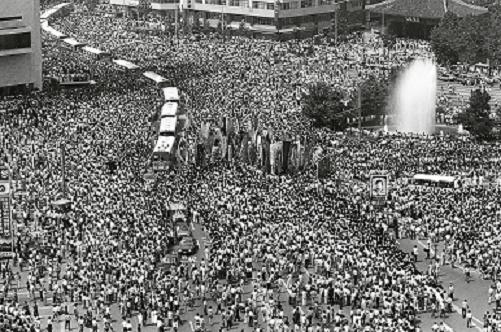
Citizens of Seoul march in the June Struggle, with a giant photo of Lee Han-yeol in memoriam.
(source)
Korean people have had enough. Over the next three weeks, the country would erupt in waves of protests, at a scale never seen before. The Chun dictatorship deployed 60,000 armed police to crack down the protests, but the police was overrun by the sheer number of the protesters. The protesters were no longer just college students; they were priests in robes, high school students in uniforms, white collar workers in suits. The protesters asked the drivers to show their support for the movement by waving white handkerchief out of their windows while honking their horns as they passed by the protesters. It was an incredible scene: the streets of Seoul were a cacophonous din of white, with every car pressing down on its horns and waving a white handkerchief.

The protests crested on June 26, when more than 1.3 million Koreans marched for democracy in 37 cities across the country. Three days later, Chun Doo-hwan capitulated and issued a statement promising direct elections and transition to true democracy. In December 1987, South Korea would hold the first free and fair presidential election in the republic’s history. Thus, Koreans achieved what Mahatma Gandhi achieved in India, what Martin Luther King Jr. achieved in America--they defeated tyranny without guns.

Got a question or a comment for the Korean? Email away at askakorean@gmail.com.
Read More
Posted in | No comments

Friday, 1 March 2013

Korean Statistic of the Day: U.S. in the Red

Posted on 18:29 by Unknown
[This title seems to be a more accurate description of the new gimmick item.]

In 2012, America's trade deficit against South Korea increased by 25 percent compared to 2011. The dramatic change is mostly attributed to Korea-U.S. Free Trade Agreement. Much of the deficit came from the automobile industry, as the U.S. deficit in the auto industry against Korea increased by 22 percent compared to the previous year. The U.S., however, managed to significantly reduce its deficit in the electronics/space/IT industry, going from $6.2 billion in deficit to $1 billion in deficit.

Got a question or a comment for the Korean? Email away at askakorean@gmail.com.
Read More
Posted in | No comments

Wednesday, 27 February 2013

Korean Fact of the Day: Less Text Messages

Posted on 18:01 by Unknown
[Can this new gimmick item last more than a few weeks? We'll find out!]

Between 2010 and 2011, the number of text messages sent and received in Korea declined precipitously, by 22.6 percent. This is the first time in the history of text messaging where the number of text messages decreased. In 2012, the number of text messages dropped by 6 to 8 percent every month.

Why? Because of the proliferation of mobile instant messaging, or MIM. In the U.S., Whatsapp, Kik Messenger or Blackberry Messanger are mildly popular, but not enough to dent the number of text messages. In Korea, MIMs such as Kakao Talk and Line have become so universally popular that virtually every Korean sends text-based messages through those services.

Got a question or a comment for the Korean? Email away at askakorean@gmail.com.
Read More
Posted in | No comments

Tuesday, 26 February 2013

Grammar Rule: Beginning-Sound Rule [두음법칙]

Posted on 19:51 by Unknown
Dear Korean,

Why is the Korean family name 노, as in 노태우 and 노무현, anglicized as "Roh"? It's both spelled and pronounced as "Noh" in Korean, and there's no reason it can't be anglicized as such in English (it's not like "Noh" is not a sound that's foreign to English).

Anonymous Coward

Basically, this happens as certain words go through two levels of transliteration--first from Chinese to Korean, then from Korean to English. Let's take a look at each step in turn.

First, the Chinese to Korean part. Korean language uses a great deal of Chinese-derived words, much like English uses a great deal of Latin-derived words. This is to be expected, given that Korea spent its entire history right next to the extremely influential Chinese civilization. But by accident of history, Korean language and Chinese language belong to two different "families"--Chinese language is Sino-Tibetan, while Korean language is Altaic. This means that Korean language actually has a vastly different grammatical style from the Chinese language. 

Because of the grammatical differences between Korean and Chinese, Chinese words go through certain modifications as they are incorporated into Korean. One of the modifications is called the Beginning-Sound Rule [두음법칙]. (Please note that this is the Korean's own translation and not the official one.) Altaic grammar tends to avoid beginning a word with "n" and "r/l" sounds in certain situations. But Chinese language has tons of words that begin with "n" and "r/l" sound. When those words are imported into Korean, they are modified according to the BSR.

If you can read Korean, you can read the official explanation of the BSR at the website of the National Institute of Korean Language, the ultimate authority on Korean grammar. Here is a quick summary of the rules:
(1) The "n" sound rule:  If a Sino-Korean word begins with 녀 [nyeo], 뇨 [nyo], 느 [neu], 니 [ni], those sounds are converted to 여 [yeo], 요 [yo], 으 [eu], 이 [yi]. 

Examples: 

- Korean word "woman" is a Sino-Korean word, spelled 女子 in Chinese. Read as it stands, 女子 should be written and pronounced as 녀자 [nyeoja]. But because the word begins with 녀, the beginning sound is converted to 여. Therefore, Korean word for "woman" is 여자 [yeoja].

-Similarly, Korean word for "pseudonym" is a Sino-Korean word spelled 匿名. This should be written and pronounced as 닉명 [nikmyeong], if the word is to be read as it stands. But because the word begins with 닉, the beginning sound is converted to 익. Therefore, Korean word for "pseudonym" is 익명 [ikmyeong].

(2) The "r/l" sound rule 1:  If a Sino-Korean word begins with 랴 [lya/rya], 려 [lyeo/ryeo], 례 [lye/rye], 료 [lyo/ryo], 류 [lyu/ryu], 리 [li/ri], those sounds are converted to 야 [ya], 여 [yeo], 예 [ye], 요 [yo], 유 [yu], 이 [yi].

Examples:

- Korean word "manners" is a Sino-Korean word, spelled 禮儀. This should be written and pronounced as 례절 [lyejeol], but 례 is converted to 예 under this rule, making the correct word 예절 [yejeol].

- A very common Korean last name is 李, which should be written and pronounced as 리 [li]. But because of the rule, 리 is converted to 이. Therefore, although outgoing president's name should be strictly read as Lee Myeong-bak [리명박], Koreans pronounce his name as Yi Myeong-bak [이명박].

(3) The "r/l" sound rule 2:  If a Sino-Korean word begins with 라 [la/ra], 래 [lae/rae], 로 [lo/ro], 뢰 [loe/roe], 루 [lu/ru], 르 [leu/reu], those sounds are converted to 나 [na], 내 [nae], 노 [no], 뇌 [noe], 누 [nu], 느 [neu].

Examples:

- Korean word for "paradise" is spelled in Chinese as 樂園, which should be read and written as 락원 [lakwon]. But the beginning 락 sound is converted into 낙, making the correct Korean word 낙원 [nakwon].

- And now, the mysterious last name of Roh Tae-woo and Roh Moo-hyun. In both cases, the last name is spelled in Chinese as 盧, pronounced 로 [lo]. But because 로 cannot start a word, the word is converted to 노. Therefore, the name is 노무현 [No Mu-hyeon], although the Chinese spelling reads as 로무현 [Lo Mu-hyeon].
Think these rules are arbitrary and without logic? You are not alone. Because these rules are completely based on language experience, there is little logic to be found in the BSR. (But then again, the same is the case for a lot of grammar rules in any language.) Because this rule is so arbitrary, there actually was a significant debate within Korean language scholars as to whether BSR should be continued in modern Korean language. 

When Korea split into North and South Korea, the linguists of North Korea and South Korea came to opposite conclusions: North Korea scrapped the BSR, while South Korea left it alone. (This is partly a function of regional dialects, as the BSR tendencies were stronger in southern Korean dialects.) Thus, Sino-Korean words that begin with "r/l", for example, are written as they sound in North Korea. Thus, North Korea's state newspaper, 勞動新聞 ["Worker's Daily"], is written in North Korea as 로동신문 [rodong shinmun], rather than 노동신문 [nodong shinmun].

Now, the second step--going from Korean to English. If (South) Koreans spell 盧 as 노 [no] rather than 로 [ro], why do the former presidents transliterate their names as Roh Moo-hyeon, rather than Noh Moo-hyeon? Here, we are dealing with an exception in the Romanization rules. The Revised Romanization rules require that Korean words are to be Romanized as they are pronounced in Korean language. Therefore, the BSR-ed words are Romanized with their changes intact. (That is, the word 낙원 would be transliterated as "nakwon", not "lakwon".) 

However, the Revised Romanization rules provided an exception for people's names. The exception is simple--people may transliterate their names however they want. For historical figures who never had a reason to write their names in English, the Revised Romanization rules stand. (Thus, the famous admiral 이순신 is Yi Sun-shin, not Lee Sunshin.) But Koreans who had the time to consider how to transliterate their names into English do not really have to follow any rule. Thus, Korea's first president 이승만 (who studied and lived in the United States for a significant amount of time) chose a rather peculiar Romanization of "Syngman Rhee," although his name would be transliterated as "Yi Seung-man" under the Revised Rominization rule.

So, to sum up, why is it "Roh Moo-hyun" instead of "Noh Moo-hyun"? Because president Roh, when he decided to Romanize his name, decided to ditch Korean grammar rule that is the Beginning-Sound Rule. This is commonly done for Koreans whose last names fall under the BSR, i.e. Lee/Yee, Roh/Noh, Ra/Na, etc.

Got a question or a comment for the Korean? Email away at askakorean@gmail.com.
Read More
Posted in | No comments

Thursday, 21 February 2013

Korean President Power Ranking

Posted on 18:46 by Unknown
On February 20, President Lee Myeong-bak held his last cabinet meeting, effectively ending his tenure as the president of Korea. (The inauguration for the next president Park Geun-hye is on February 25.) With another president into the pages of Korean history, it seems like a good time to have . . . the presidential power ranking!

Technically, the Republic of Korea has had ten heads of government since its birth in 1948: (1) Syngmn Rhee (1948-1960); (2) Chang Myon (1960-1961); (3) Park Chung-hee (1961-1979); (4) Choi Gyu-ha (1979-1980); (5) Chun Doo-hwan (1980-1987); (6) Roh Tae-woo (1987-1992); (7) Kim Young-sam (1992-1997); (8) Kim Dae-jung (1997-2002); (9) Roh Moo-hyun (2002-2007) and; (10) Lee Myeong-bak (2007-2012). But one can see that Chang Myon and Choi Gyu-ha did not last very long, because they abdicated from their posts when their successors rolled into Seoul with tanks.

(Note:  Several commenters pointed out that Yoon Bo-seon, not Chang Myon, was the president after Syngman Rhee. That comment is technically correct, but it is not a fair comparison. Korea's short-lived Second Republic was a proportional representation system, in which the people elected the Prime Minister, the head of government. The National Assembly elected the president, the nominal head of state without much real power. Yoon Bo-seon was the president; Chang Myon was the prime minister. Therefore, apples-to-apples comparison should involve Chang Myon, not Yoon Bo-seon.)

Thus, a fair ranking would involve eight presidents. How would they stack up? Here is the Korean's ranking, in reverse order.

(More after the jump)

Got a question or a comment for the Korean? Email away at askakorean@gmail.com.


TIER 3:  MASS MURDERERS

8.  Chun Doo-hwan [전두환]

(source)

Term:  1980-1987

Positives:  Won the bid for 1988 Seoul Olympics; decent economic growth (amid worldwide bull market) without runaway inflation.

Negatives:  Came to power by rolling into Seoul with tanks and killing his fellow soldiers; mass murder at Gwangju; unprecedented oppression of civil liberties; inconceivably huge slush fund.

We start the reverse-order list with Chun Doo-hwan, the brown standard of the shit list. The word "president" is wasted on him. He was a military thug who came to power illegitimately by a coup d'etat. When the city of Gwangju revolted in protest of his usurpation of power, he sent paratroopers to massacre hundreds of Gwangju citizens. Dissidents were arrested and tortured; newspaper editors were dictated tomorrow's news at gunpoint. Chun amassed more than a billion dollars in his slush fund, a staggering sum for  Korea in the 1980s.

If you squint real hard, there are a couple of redeeming points during Chun's presidency. It was a remarkable feat for a developing country like Korea (at the time) to win the bid for the Olympics. The economy also grew in a reasonable way, although that is more thanks to Korea's economic technocrats whom Chun left undisturbed. But the blood of hundreds of people on his hand puts him squarely at the bottom of this list.

7.  Roh Tae-woo [노태우]

(source)
Term:  1987-1992

Positives:  Began transition to democracy; solid effort to improve relations with Russia and China.

Negatives:  Came to power on Chun's coattail; directly responsible for Gwangju massacre; pretty damn huge slush fund.

Roh's rise to power was somewhat of a fluke. After Chun's reign was over and democracy was instituted, the pro-democracy opposition was not able to field a single candidate. With Kim Young-sam and Kim Dae-jung splitting the votes, the previous dictator's right-hand man became the president with only 36% of the votes.

As the president, Roh Tae-woo was not terrible. He undid the worst aspects of Chun's dictatorship such as the government's control of media. He sought to improve ties with Russia and China, and was generally successful. This maneuvering would permanently put South Korea at a position superior to that of North Korea in the international stage. 

But the simple truth is that, if Chun Doo-hwan did not roll in with tanks with his buddy in the tow, Roh Tae-woo would have been a nobody. The blood of Gwangju citizens stains Roh's hands as well, as he was the one directing the military to shoot at civilians. And although not quite as staggering as Chun's slush fund, Roh Tae-woo did well for himself in the corruption front, amassing $500 million in his slush fund.

6.  Syngman Rhee

(source)
Term:  1948-1960

Positives:  Established the Republic of Korea; defeated North Korean in Korean War; land reform.

Negatives:  Attempted to be the lifetime president by arbitrarily changing the constitution and rigging elections; paved the road to fascism; mass murder of civilians before and during Korean War.

Syngman Rhee was a Machiavellian politician both domestically and internationally, maniacally focused on power and prone to bold and unexpected actions--not unlike Kim Il-Sung, his counterpart in the north. 

Rhee is ranked higher than Chun and Roh because Rhee's achievements are more substantial. He extracted as much as he could from the United States, Korea's chief protector, by repeatedly engaging in political brinksmanship. He oversaw a bold land reform that put his fledgling country on a solid path, by providing most Koreans with a sense of ownership to their nation. During Korean War, Korea was literally facing an existential threat, and due credit must be given to Rhee's leadership for preserving the republic.

But Rhee's failures are equally substantial. Fundamentally, he was uninterested in democracy and maneuvered to turn himself into a king, until he ran out of options. The damages from the precedents he created--rigging elections, hiring thugs to break up the opposition meetings, arbitrarily changing the constitution--set back Korea's democracy before it even began.

More importantly, Rhee cannot escape the tag "mass murderer," as he oversaw a brutal crackdown of a leftist uprising in Jeju and Yeosu/Suncheon. There, Rhee ordered the civilians who assisted the leftists to be executed as well. Korean military would slaughter at least 20,000 civilians in the process of quelling the rebellion. This mass murder is slightly more forgivable (to the extent any mass murder is ever forgivable) than the Gwangju massacre, because South Korea was extremely unstable, and the threat of communist overthrow of South Korea was quite real. Jeju/Yeosu/Suncheon may be characterized as guerrilla warfare; Gwangju was a straight massacre. But be that as it may, it is difficult to put a kind judgment on any mass murder of civilians.

TIER 2:  MIDDLING MANAGERS

5.  Lee Myeong-bak

(source)
Term:  2007-2012

Positives:  General elevation of Korea's international stature; decently handled worldwide financial crisis.

Negatives:  Environmentally disastrous Four Rivers Project; civilian surveillance program; huge step back on media freedom; non-existent North Korea policy

The outgoing president comes in at fifth place, which more or less means that the only thing separating him from the previous three is that he is not a mass murderer. During Lee Myeong-bak's presidency, the democracy of Korea took a big step back. More than 200 journalists were fired or otherwise penalized for expressing opposing views. The National Intelligence Service--Korea's spy agency--ran a surveillance program on ordinary civilians who supported the liberal politicians. What is more, Lee made a foolishly naive proposal to North Korea that suggested de-nuclearization in exchange for aid, which was only repaid with attacks on South Korean naval ship and its northern island of Yeonpyeong-do. His major campaign promise, the Four Rivers Project, failed to deliver: it was revealed to be little more than a vehicle to siphon government contract money to construction companies, while causing an environmental disaster of Korea's major rivers.

Lee Myeong-bak was not all bad. He was a solid diplomat, and Korea rose to a new height internationally under his watch. When the worldwide financial system went to hell in 2008 following the Lehman Brothers bankruptcy, Korea managed to maintain positive growth and low unemployment.

The Korean suspects that, in three years or so, Lee's presidency would regain at least a little bit cache based on the benefit of hindsight. But today, as he is counting down the last days of his presidency, he is where he is.

4.  Roh Moo-hyun [노무현]

(source)
Term:  2002-2007

Positives:  Prosecutor's Office reform; Korea-U.S. Free Trade Agreement.

Negatives:  Income polarization; nuclear North Korea; strained relationship with U.S.

The Korean previously wrote that Roh Moo-hyun could arguably be the third best president in Korean history. Upon further reflection, fourth place would be more appropriate.

With the benefit of the hindsight, Roh Moo-hyun's presidency was average. He had achievements, but none particularly huge or long-lasting. The same is true for his failures. (If you are ungenerous, you could fault Roh for nuclear North Korea; but from what we have seen so far, pretty much nothing would have stopped nuclear North Korea anyway.) The only meaningful failure on Roh's part is that his unpopularity--arising from his political ineptitude--crippled the electoral chances of Korea's progressives; the effect of this failure manifested itself once more in the previous election.

Because Roh belonged to the minority faction of the minority party, he had limited practical ability to implement any huge and ambitious program. For his legacy, that was probably for the better.

3.  Kim Young-sam [김영삼]

(source)
Term:  1992-1997

Positives:  Clean break with the military rule; consolidation of democracy; transparency of financial transactions.

Negatives:  The "three-party merger" deal with Chun Doo-hwan and Roh Tae-woo; 1997 East Asian Financial Crisis.

With Kim Young-sam, we are now approaching a point where the positives are beginning to outweigh the negatives. Kim Young-sam came to power by making a deal with the devil. In 1990, he made a pact with Roh Tae-woo to merge his party into Roh's such that he would succeed as the majority party candidate after Roh's presidency. For a man who dedicated his life to democratization movement, this was a stunning turn of events.

Kim Young-sam somewhat redeemed himself after he became the president. His administration prosecuted Chun Doo-hwan and Roh Tae-woo, putting them in jail for treason. Kim Young-sam also destroyed the ties between politics and the military, putting Korean democracy out of the reach of the military coup d'etat once and for all. Kim also ordered all financial transactions to be made in real-name basis, instantly improving Korea's transparency and providing a real foundation to become the first world economy.

But it was not to be within his term. Kim Young-sam finished his term while witnessing Korea undergo the greatest economic disaster in its history--the East Asian Financial Crisis of 1997. The financial crisis fundamentally altered Korea's national character into a more neoliberal, ruthless kind that it is today.

TIER 1:  THE GREATS

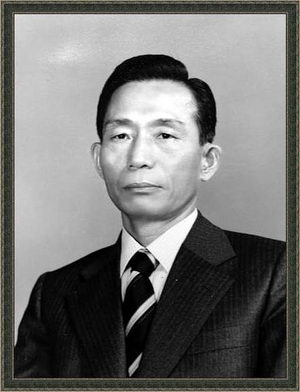
2.  Park Chung-hee [박정희]

(source)
Term:  1961-1979

Positives:  Economic growth at a level unprecedented in human history; put South Korea at a position clearly superior than North Korea.

Negatives:  Nearly irreparable damage to Korean democracy; fascist thuggery; destruction of civil liberties; assassinations and attempted assassinations of opponents.

It is with gritted teeth that the Korean places Park Chung-hee in the tier of great Korean presidents, because the Korean simply cannot tolerate the rulers who so carelessly disregard democracy and freedom. But the truth is undeniable: under Park Chung-hee's leadership, Korea experienced the greatest economic growth in human history (that is only recently surpassed by China.) It is likewise undeniable that the economic growth made the lives of Korean people incomparably better than the lives of the previous generation.

Does that excuse Park's many abuses? The assassinations and tortures of his political opponents? Or the policemen in the streets with scissors, cutting the hair of any young man who had long hair in the name of public order? Or the creation of Korea's political culture (which lasts to this day) that prizes economic advancement over democracy and freedom? That is precisely the debate with which Koreans have been grappling for the last three decades, and there will be no single answer. 

1.  Kim Dae-jung [김대중]

(source)
Term:  1997-2002

Positives:  Peaceful transition of power; forgiveness and reconciliation; deliverance from the financial crisis; Sunshine Policy (maybe).

Negatives:  Sunshine Policy (maybe).

Here is the greatest president in Korean history: Kim Dae-jung, who was also the most prominent leader of Korea's democratization movement.

Upon winning the election after Kim Young-sam's term, Kim Dae-jung could have reverted Korean democracy into the bad old days. DJ (as he was known) could have arrested YS on trumped-up charges or harass Kim Young-sam's political followers with groundless investigations. (In fact, this is exactly what Lee Myeong-bak did to Roh Moo-hyun.) But Kim Dae-jung, a remarkably principled man of democracy, rose above the temptation. Not only did he leave Kim Young-sam alone, but he also pardoned Chun Doo-hwan and Roh Tae-woo, the military dictators that tried to kill him.

Kim Dae-jung's achievement as the president was also significant. He led Korea out of the East Asian Financial Crisis and put Korea on the path of very speedy recovery. (And thanks to the measures taken during the East Asian Financial Crisis, Korea mostly skirted the dangers from the 2008 global financial crisis.) Kim Dae-jung also had the foresight to make massive investment into high-speed Internet in Korea, which has paid incredible dividends by vaulting Korea into a world-leading technology innovator.

The sole arguable failure by Kim Dae-jung was Sunshine Policy, in which South Korea began the course of diplomacy and dialog with North Korea. Whether the Sunshine Policy saved North Korea from collapse or defused a likely war in Korean Peninsula is an ongoing debate. But assuming that the truth is somewhere in the middle, Kim Dae-jung's achievements simply put him head and shoulders above all other Korean presidents.

*                *                *

Bonus Entry.  Where would Park Geun-hye likely place in the list, five years from today?

Park has a potential to be great, largely because of the historical contingencies that may occur in her term. There is a realistic chance that North Korea may suddenly collapse in the next five years, and Korea will be reunified. If Park Geun-hye handles the reunification process well, that would easily vault her into Tier 1, and a serious discussion will have to be made about whether she is the greatest president in the history of Korea.

Even if the reunification does not happen, Park Geun-hye could put herself at the top of Tier 2/bottom of Tier 1 if she keeps her campaign promises and puts Korea on the path of becoming modern welfare state. Economically, two Korean presidents changed Korea in a major way: Park Chung-hee turned Korea into a modern industrialized nation, and Kim Dae-jung turned Korea into a post-modern, IT-industry based nation. Both changes transformed Korea's complexion in a fundamental way. Park Geun-hye's campaign promises have the same level of potential.

However, early returns indicate that Park Geun-hye's promise to construct a welfare state was not much more than an enterprising campaign tactic to deprive her opponents' main talking point. If this trend continues, Park Geun-hye will not amount to much more than a reprise of Lee Myeong-bak.

Got a question or a comment for the Korean? Email away at askakorean@gmail.com.
Read More
Posted in | No comments

Friday, 15 February 2013

Interesting Updates on the Last Post

Posted on 17:38 by Unknown
There are some interesting updates on the last post on the Godfather offer for Korean reunification. Shortly after the Korean wrote the post, Lee Myeong-bak, the outgoing South Korean president, made a number of remarks that are quite relevant to the premises in the Korean's cockamamie plan to reunify Korean peninsula. To wit:
"We cannot make North Korea give up their nuclear weapon through dialogue and negotiation. We cannot expect them [North Korea] to give up their nuclear weapon before the regime changes and collapses." 
-- President Lee in a preliminary address in a breakfast meeting held on Feb. 15. This is the first time any democratically-elected South Korean president openly discussed the possibility of regime change in North Korea.
"Beginning in the middle of Hu Jintao's time in the office, China has told us: 'Please don't think we are only on the side of North Korea.' This is what China thinks, in its heart of hearts . . . There is a lot of talk about how a peaceful reunification led by South Korea does not go against China's interest. Although the Chinese government would not official make these statements, there are a lot of scholarly papers and research projects along these lines. This is the beginning of a very important change."
-- President Lee in an interview with Dong-A Ilbo, his last interview as the president. If this trend continues, it is hardly a pipe dream to think that China may join in the effort to induce a regime change in North Korea, or at least would not stand in the way of South Korea-led efforts to reunify that is short of a military conflict.
"We have been letting them [China] know that the U.S. military base will never be moved to North Korea after the reunification, that U.S.-Korea alliance would not affect the U.S.-China relationship, and that Korea can play the role of a peacekeeper when the interests of U.S. and China conflict with each other's. We began discussing this at the summit level.  . . .  At this point, China tells us what they do with North Korea. If they visit North Korea, they let us know that they did."
-- From the same interview. This is a huge statement on multiple levels. First, South Korea has been engaged in a summit-level conversation with China as the the contingency of North Korean collapse. Second, such conversation has covered such specific points as where the USFK will be after the reunification. In a different part of the interview, President Lee also mentioned that South Korea and China began discussing what to do with North Korea's nuclear weapon in case of North Korean collapse. Apparently, the tentative proposal is to have the United Nations inspectors seal and control the weaponry.
"There are people who hypothesize that (in case of an exigency) North Korea would call upon the Chinese military, and the military would not leave once it occupies North Korea. But the ethnic minority issue is the biggest headache for China. Just think about Tibet, Xinjiang... Turning North Korea into another ethnic minority territory is not something that China can do haphazardly."
-- Again, from the same interview. Unlike other statements here, this statement is based more on President Lee's own opinion rather than on his interaction with China. To me, the argument seems reasonable, although a little on the speculative side. Regardless, it is highly interesting.

Another development that has been interesting is that South Korea's progressives, traditionally in favor of dialogue and cooperation with North Korea, have been quietly nodding at these statements rather than objecting to the idea of regime change in North Korea. It appears that, after 15 years of debate about what to do with North Korea, a loose consensus has emerged in South Korean politics. The next decade will be an interesting time to watch.

Got a question or a comment for the Korean? Email away at askakorean@gmail.com.
Read More
Posted in | No comments

Wednesday, 13 February 2013

The Godfather Offer for Korean Reunification

Posted on 19:32 by Unknown
On February 12, North Korea conducted its third nuclear test in six years. Although the Korean previously yawned at North Korea's nuclear tests, there are reasons to think that this time is different from the last two, and we should start to worry. This is not to say that you should cancel your vacation plan of visiting Korea: the Korean can confidently say that today's Seoul, or any other part of South Korea, is exactly as safe as it was on February 11, and will remain so until something far more threatening than a nuclear test happens. Here, the Korean is talking about geopolitical concern--as in, how the situation will develop in the years ahead.

The most worrisome part is this round of nuclear testing is that, this time, North Korea seems to be successful in developing a real nuclear weapon, or at least very close to it. One of the reasons why the previous two tests were not as worrisome was because there was no real confirmation that those tests were successful. The first test did not even produce a kiloton of explosive power, and was derided as a "fizzle". The second test created a bigger bang, but the tremor it caused was still barely detectable. 

Not so this time: the test from yesterday registered 4.9 on the Richter scale, indicating that this is a real deal, or at least pretty close to it. It is estimated that the nuke from yesterday was approximately one-third of the power of the Hiroshima bomb, and four times greater than North Korea's second test. There is also a possibility that this bomb is a uranium-based bomb rather than a plutonium-based one, which means North Korea would be able to mass produce nuclear weapons. Further, it must be remembered that, only six weeks ago, North Korea successfully launched a rocket (which can easily be turned into an ICBM) that is able to strike the West Coast of the United States. The cash-hungry North Korea can attempt to sell some or all of its technology to just about anyone in the world.

I am not trying to be alarmist. I certainly do not think there is any danger of Seoul in a mushroom cloud, or a nuclear missile flying to Seattle, any time soon. (Really, I don't.) But I do worry about what will happen in 10 years or so. While there is no confirmation that North Korea has developed a miniaturized nuclear warhead that may be equipped onto an ICBM, the trend of development is unmistakable at this point: North Korea is forging its way to that point, and it will get there sooner rather than later.

Equally predictable is the likely reaction from South Korea and to a lesser degree, Japan. At this point, these two American allies are bereft of any more meaningful options to assure themselves that a nuclear weapon is not headed their way. Sooner or later, South Korea and/or Japan will want to arm themselves with nuclear weapons as well, or, at least equip themselves with the missile capacity to intercept any incoming nuclear weapon. Already, in response to the test, South Korean policymakers are starting to discuss the need to develop the capacity for "mutually assured destruction." (In fact, South Korea attempted to develop its own nuclear weapons in the 1970s, until the Americans put a stop to it.) A possibility that could be achieved even more easily is for the U.S. to re-deploy tactical nukes in South Korea--recall that, from 1958 to 1991, U.S. stored tactical nuclear weapon in South Korea until the first Bush Administration withdrew them.

This is not an appealing picture for the world's number 2 superpower, China. If there were nuclear weaponry available in South Korea and Japan, China would--not unjustifiably--consider the situation be a severe threat. It is not difficult to imagine that even a small spark, just one itchy trigger finger over, say, the dispute between China and Japan with respect to the Diaoyou/Senkaku Islands, could cause a nuclear war.

In sum, we could be headed toward a kind of four-way prisoner's dilemma: a situation in which the decision to pursue the short term interest, without knowing other parties' intentions, leading to the detriment of the long term interest for every player involved. (Here, infuriatingly, North Korea is the warden that holds the key.) Nobody--not U.S., not South Korea, not Japan, and not even China--wants to live in a nuclear tinderbox, yet we could be moving that way.

Is there a way out? If the Korean can propose a cockamamie scheme to fix America's immigration problem and put away the historical issue between Korea and Japan once and for all, why wouldn't he be able to come up with a cockamamie scheme to get out of this mess? Sure, the plan would require a level of boldness on the part of every party, such that it will almost certainly never happen. Which is why it belongs on a blog.

(More after the jump.)

Got a question or a comment for the Korean? Email away at askakorean@gmail.com.

*               *               *

Here is the central consideration that drives this plan: what North Korea wants to achieve through a nuclear weapon is regime survival. Truly, this is the only thing North Korea wants. And North Korea will hang onto its nuclear weapon only as long as its regime--that is, Kim Jong-un and his cronies--continues to survive. This has been obvious from the very beginning of North Korea's nuclear development.

Ignoring this obvious motivation leads to disastrous results. The prime example of this was South Korean president Lee Myeong-bak's North Korean policy, which was particularly foolish. As he took the office, President Lee proposed a bargain with North Korea: if North Korea gave up its nukes and opened up its economy, South Korea would provide enough aid and investment to push North Korean per capita GDP to $3,000. How did North Korea react to that proposal? Two nuclear tests, bombing of a South Korean naval vessel and shelling of a South Korean island near the maritime border during Lee's tenure. Why? Simple: the North Korean regime doesn't give a shit about its country's per capita GDP.

This central consideration comes with a depressing corollary: it is likely that North Korea will never give up its nuclear weapon, because there is practically no way to truly guarantee North Korea's regime survival. For now, let us set aside the moral repugnance of bribing the North Korean totalitarianism that let 330,000 of its people starve to death and runs death camps that are properly comparable to Auschwitz. Practically speaking, North Korea is so decrepit, and its people so benighted, that there is no real way to achieve true stability with North Korea that guarantees the regime survival. Forget liberal democracy; North Korea would not even survive if South Korea surrendered today and agreed to reunify under North Korea's terms. If that were to happen, South Korea's wealth and quality of living--incomparably greater than those of North Korea--would destroy North Korea from inside out. The result is the same if North Korea were to develop economically. If North Koreans achieved a quality of living comparable to, say, Vietnam, the Kim Jong-Un regime would not survive.

Fundamentally, North Korean regime survives like the way any other totalitarian regime has survived in history--by constantly manufacturing a series of external, existential threats, which are used to justify the oppression of its own people. In short, North Korea needs crises to survive. And North Korea needs the nukes to continue manufacturing the crises. So why would North Korea ever give up its nukes?

*               *               *

So we are back to the four-way prisoners' dilemma: the U.S. will have its West Coast targeted with nuclear ICBMs, and will not be able to stop nuclear proliferation out of North Korea, while Northeast Asia rushes to another nuclear arms race. Nobody wants this to happen, but we are headed down that road anyway. But is there a way out?

Here is one way out: induce a rapid collapse of North Korean society, depose the Kim Jong-Un regime, and reunify the Korean peninsula. I know that this sounds implausible, radical and dangerous. But as long as the North Korean regime links the possession of nuclear weapon with its life, the only way to dispossess the nuclear weapon is to end that life. The timing has to be now, before North Korea does manage to actually put a nuclear warhead on an ICBM. Further, there are good reasons to think that this plan could work, and the risks of this plan is not as high as one might think.

This is how the plan could look like. The most important key word in this plan is "rapid." The collapse must be rapid--as in, within less than a month--in order to minimize the risk involved by taking away the time for the Kim regime to react. Because North Korea is so decrepit, this can be easily achieved as long as there is concentrated effort. The most efficient way is, obviously, through China. For example, North Korea imports nearly all of its petroleum from China. All of the petroleum passed through a single point in the China-North Korea border--through the city of Dandong. Shut down the spigot, and the North Korean economy (such as it is) grinds to halt within weeks. (In fact, China did shut down the spigot for three days after North Korea's second nuclear test, to express its displeasure.)

But there are a number of ways that South Korea alone can induce a collapse without the Chinese help. President Park Geun-hye, for example, could issue a statement reaffirming South Korea's constitutional provision that North Koreans are also the citizens of the Republic of Korea, and announce that any North Korean outside of North Korea will receive South Korea's diplomatic protection. South Korea could also establish a safe passage through the DMZ, and invite any North Korean to defect. These measures are designed to cause a massive stream of defection to the point that the regime could no longer control its people's movement. The U.S. can join in the party as well. Joshua Stanton's suggestion to hit the pocketbooks of North Korean regime's "palace economy" is a good one, and could also seriously destabilize the North Korean regime.

Next is the hard part: at some point along the way, China must join this plan. Ideally, China would join the plan from the very beginning and participate in the North Korean embargo. This possibility is admittedly remote, but not as outlandish as one might think. There is simply no love left for North Korea among China's populace, and there are signs that even the Chinese leadership is exasperated with North Korea. Although China taking an active role in North Korea's demise is unlikely, it is not unthinkable.

The more likely path is for South Korea and U.S. to force China into a choice. U.S. and South Korea can earnestly move toward collapsing the North Korean regime, and make China confront the question: do you really want to go to war against your first- and third-largest trading partners, over Kim Jong-Un? With the right kinds of inducement--the Godfather offer that China cannot refuse--U.S. and South Korea can get China on board.

What would such inducement look like? Given the importance of China in this plan, the inducement must cater to China's policy preferences to a degree that may seem excessive. Ultimately, China is keeping the North Korean regime on life support because of two benefits: (1) stability, and (2) buffer against the potential overland American invasion (however unlikely that may be.) With North Korea openly defying Beijing's orders to stand down on the nuke test, the stability rationale is already on weak grounds. China must be made to understand that, if North Korea can be pushed to the point of teetering, South Korea's absorption of North Korea--i.e. reunification--is the only realistic way for lasting stability, because South Korea is the only country in the world that has the ability and willingness to take on that task. With that in mind, this could be the package that South Korean and the U.S. can offer to China:
  • Right to occupy up to 3 North Korean cities for 100 years:  Like Hong Kong and Macau, China could occupy certain cities--say, Rajin/Seonbong and Shinuiju--and govern them for a century, however they would like.  Alternatively and/or in addition, China could be given special economic rights over North Korean resources, such as mining rights.
  • Shoot-to-kill border control:  This is harsh, but necessary to cater to China's interest. China simply cannot afford to have a million North Korean refugees streaming out of the country and into China. South Korea could also offer compensation for China's cost of arresting and deporting (former) North Koreans back across the border.
  • U.S. withdrawal of ground troops from Korea:  The rationale for this is obvious. If U.S. balks at this, South Korea and U.S. can offer to China that USFK will not be deployed to any other place in the Korean peninsula that it is not currently deployed in.
Under normal circumstances, China would likely say no to these offers. But if China is pushed into a decision in the face of impending North Korean collapse, these terms may be enough. In exchange, China could participate in the plan to collapse North Korea, or at least stand aside as South Korea and U.S. continue to shake the tree. For old time's sake, China could also offer a safe haven for Kim Jong-Un and his cronies to exile, accelerating the process of peaceful transition.

*               *               *

Unfortunately, this plan suffers from two large risk factors. First, China may not be amenable to the Godfather offer after all. Instead--perhaps because of clumsiness on the part of South Korean and American diplomatic corps, which is certainly not beyond their ken--China may perceive a South Korean/American attempt to collapse North Korea as a threat to itself. The result may be that North Korea survives, and remains even more hostile. But with skillful negotiation, which would include a firm reminder to China that shielding North Korea is not compatible with China's interest in the long run, this risk factor can be managed.

More significant is the second risk factor: the uncertainty as to exactly what would happen as North Korea collapses. Ideally, collapse will lead to a brief period of total anarchy, at which point the South Korean military could swoop in to take control. But many things can go wrong in this process. The collapse, for example, can take the form of a rival group (that is not much better than the current regime) taking over the country. Once the rival group takes control, it may aim North Korea's nuclear weapon to anyone who dares to take over.

This risk is real, and I do not intend to minimize it. But I also believe that this risk is less than one might think. North Korea's conventional war-making capabilities are practically nonexistent at this point. Its weapons are antiquated and rusty, and North Korea lacks the petroleum to operate them for any meaningful stretch of time. What North Korea can do is to attack Seoul with artillery and short-range missiles exactly once, before American and South Korean air force reduce the artillery and missile bases to rubble. Indeed, this capability, along with China's backing, is the only measure of deterrence that North Korea possesses. But a proper emphasis should be placed on the word "deterrence." Once the deterrent force is used, it is no longer a deterrent force. Again, North Korea has little capability to wage a conventional warfare. If the South Korean military begins to push across the DMZ, what would be the point of shelling Seoul? Sure, hundreds of thousands of Seoul citizens could die. But that would not stop the South Korean advance.

Which leaves us with North Korea's nuke. We know that it is real. We also know that it is not yet at the point that can be effectively weaponized and delivered to the target. (This is, again, a big reason why North Korea should be disarmed sooner rather than later.) Also, even if North Korea has weaponized nuclear bombs, we know that it cannot possibly have more than a handful of them. In that case, North Korea's nuclear weapons are ultimately just another form of deterrence writ large. Once used, they no longer deter.

The gamble--indeed, probably the most central gamble in this entire plan--is that the North Korean regime (whether headed by Kim Jong-Un or some other dictator) would not have the capacity, or willingness, use its nuclear weapon as it stares down its inevitable demise. There is a good chance that they do not have the capacity. Even if they do, it would not be rational for them to use the nuclear weapon. And regardless of the external image to the contrary, the North Korean leadership has always been a rational actor--ruthless, murderous and terrible, but still rational.

But desperation is known to cause irrationality. Does anyone in the world have the stomach to gamble with a potential nuclear weapon hitting your soil? Likely not, so there goes this crazy idea.

Got a question or comment for the Korean? Email away at askakorean@gmail.com.
Read More
Posted in | No comments
Newer Posts Older Posts Home
Subscribe to: Posts (Atom)

Popular Posts

  • Grammar Rule: Beginning-Sound Rule [두음법칙]
    Dear Korean, Why is the Korean family name 노, as in 노태우 and 노무현, anglicized as "Roh"? It's both spelled and pronounced as ...
  • Ask a Korean! News: Sen. Grassley Says Goodwin Liu has "Communist China" Mindset
    Here is a bit of a background. Goodwin Liu is a professor and associate dean of Boalt Hall Law School at U.C. Berkeley. President Obama nomi...
  • 50 Most Influential K-Pop Artists: 20. Crying Nut
    [ Series Index ] 20.   Crying Nut [크라잉넛] Years of Activity: 1998-present Members: Park Yoon-Sik [박윤식] - Vocal, Guitar Lee Sang-Myeon [이상면...
  • (no title)
    According to a survey by Mastercard, the most favored out-of-country travel destination for Koreans was Japan: 36 percent of Koreans who wer...
  • The Mosquito Truck
    Dear Korean, What chemicals are used in the mosquito fogging trucks and are they harmful to people? If so, why are they so accepted by Korea...
  • Pop Music Disappointments, and K-Pop
    The Korean saw this some time ago:   12 Extremely Disappointing Facts about Popular Music . Just to give a few samples: Flo Rida's “Low”...
  • IMF Bailout of Korea During East Asian Financial Crisis -- Interlude
    [ Series Index ] How ironic is it that as this blog discusses the IMF bailout of Korea during the East Asian Financial Crisis of 1997-98, U....
  • 50 Most Influential K-Pop Artists: 21. Lee Seon-Hee
    [ Series Index ] 21. Lee Seon-Hee [이선희] Years of Activity: 1985-present Discography: Oh the Good Old Days [아! 옛날이여] (1985) Lee Seon-Hee v...
  • 50 Most Influential K-Pop Artists: 19. Kim Wan-Seon
    [ Series Index ] 19.  Kim Wan-Seon [김완선] Also romanized as:   Kim Wan Sun Years of Activity:  1986-present? (Last regular album in 2005, a s...
  • 50 Most Influential K-Pop Artists: 30. Sinawi
    [ Read more reviews from the Korean from the   Library Mixer . To join,   click here .]   [ Series Index ] 30.   Sinawi [시나위] Also Romanized...

Blog Archive

  • ▼  2013 (73)
    • ▼  October (3)
      • Name Change in Korea
      • 50 Most Influential K-pop Artists: 12. Rain
      • Excreting the Dregs
    • ►  September (5)
    • ►  August (7)
    • ►  July (8)
    • ►  June (7)
    • ►  May (6)
    • ►  April (8)
    • ►  March (18)
    • ►  February (6)
    • ►  January (5)
  • ►  2012 (101)
    • ►  December (8)
    • ►  November (6)
    • ►  October (3)
    • ►  September (6)
    • ►  August (2)
    • ►  July (6)
    • ►  June (8)
    • ►  May (7)
    • ►  April (13)
    • ►  March (13)
    • ►  February (12)
    • ►  January (17)
  • ►  2011 (294)
    • ►  December (24)
    • ►  November (19)
    • ►  October (25)
    • ►  September (22)
    • ►  August (24)
    • ►  July (17)
    • ►  June (25)
    • ►  May (23)
    • ►  April (33)
    • ►  March (30)
    • ►  February (22)
    • ►  January (30)
  • ►  2010 (32)
    • ►  December (24)
    • ►  November (8)
Powered by Blogger.

About Me

Unknown
View my complete profile